
Lebanon · 2025
KSC-800J Water Well Rig in Lebanon: 300 mm Holes to 800 m
A KSC-800J water well drilling rig was delivered to Lebanon in November 2025. It drills 300 mm holes to 800 m using a 1200/8 power unit and a high-torque mechanical top drive, and the operator reports very high efficiency and strong performance when recovering stuck pipe at depth.
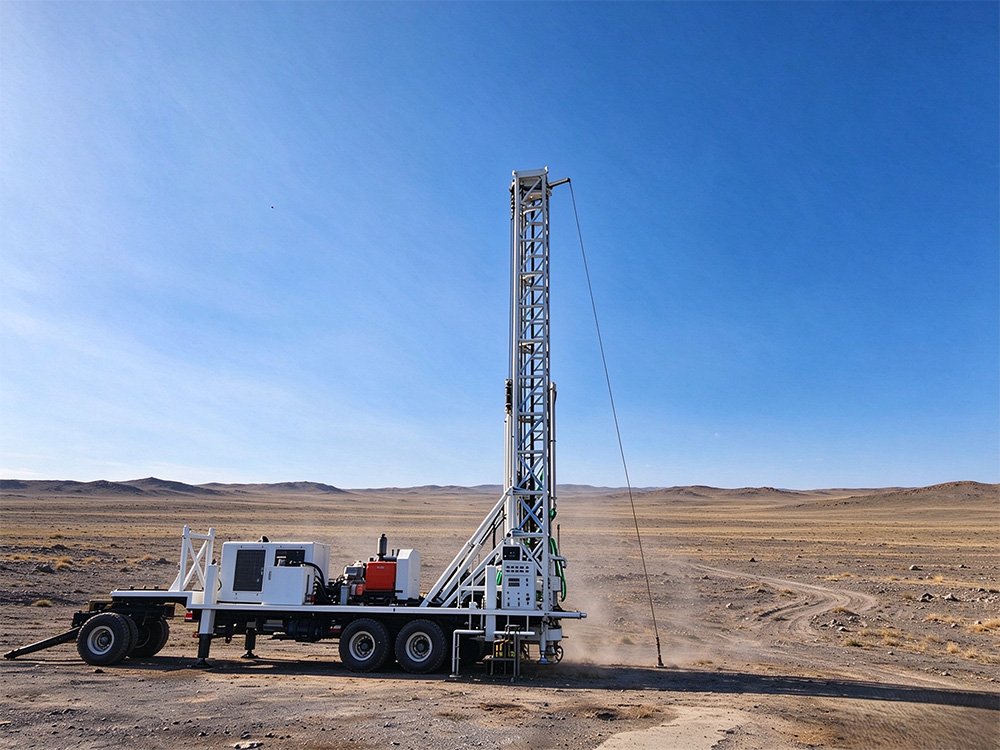
# KSC-800J Water Well Rig in Lebanon: 300 mm Holes to 800 m
In November 2025 a KSC-800J water well drilling rig was delivered to a customer in Lebanon. The machine is drilling 300 mm diameter water wells to a depth of 800 m, powered by a 1200/8 unit and driven through a mechanical top drive. In the operator's own words, the rig is working at very high efficiency — and the part of the job that has impressed them most is how it handles stuck pipe at depth.
## The hole: 300 mm to 800 m
A water well at 800 m is a depth job before it is anything else. Every decision on the machine — the mast, the string, the rotary drive, the power unit — has to be matched to the full depth, not to the top few hundred metres. At 300 mm the hole is not oversized, but it still has to be kept clean and open all the way down, which is where the drive and the fluid system earn their keep.
The KSC-800J was selected as the rig class for that depth, paired with a 1200/8 power unit so the machine could hold its parameters as the string went deeper.
## Why the top drive matters when the string sticks
Stuck pipe is the part of deep water well drilling that costs operators the most time. It usually starts small: cuttings settle around the string, a formation tightens in, or the wall starts to close. From there the question is whether the rig can work the string free without damaging it.
A **mechanical top drive with high torque** is the tool for that job, and it is exactly what the customer highlighted in their feedback:
- **Torque at the top of the string.** The drive turns the string directly, so full torque is available at the point where it is needed — no losses through a long kelly, and no waiting to build up rotation.
- **Rotation and circulation together.** Because the drive feeds fluid into the string through a swivel, the pump can keep running while the string is worked. On a stuck string, mud that keeps moving around the pipe is often what stops the situation getting worse.
- **Hydraulic drive response.** A hydraulic drive gives the operator fine control over rotation and feed — the machine can be worked up and down the string in small, controlled movements instead of one heavy pull.
Put together, that combination is why the operator reports strong results recovering stuck pipe at 800 m rather than having to abandon the hole.
## Water wells: what the machine delivers
The rig has been running on water well work since delivery, and the feedback from site is straightforward: high drilling efficiency, and a top drive they trust when the hole gets difficult. For an operator, that second point matters more than any single figure on a datasheet — a rig that can work a string free is a rig that finishes the well.
## Planning a deep water well?
Target depth, hole diameter and the formation you expect are usually enough to narrow the configuration down — including whether a top drive and which power unit suit the job. Tell us the three and we will come back with the rig class, the drive and the air or fluid package that fit.